As America celebrates 250 years of freedom, I’ve been thinking about a different kind of freedom.
Not political freedom. Financial freedom.
Because while we live in one of the freest countries in the world, many people still feel trapped when it comes to money. They feel trapped by debt, trapped by monthly payments, trapped by living paycheck to paycheck, and trapped by the constant stress of wondering whether there will be enough money left at the end of the month.
If you’ve ever laid awake at night wondering how you’re going to pay for a car repair, cover a medical bill, or make it to the next payday, you know exactly what I’m talking about.
That’s why I think financial freedom is one of the most misunderstood phrases in personal finance.
What Does Financial Freedom Actually Feel Like?
Defining Financial Freedom
Ask ten people what financial freedom means, and you’ll probably get ten different answers. Some people think it means becoming a millionaire. Others think it means retiring early. Some think it means having enough investments that they never have to work again.
Those are all worthy goals, but that’s not how I define financial freedom.
In my book, Level Up Your Finances, I define financial freedom as paying off all consumer debt and building a fully funded emergency fund of three to six months of living expenses.
That’s it.
Simple. Clear. Achievable.
I define it this way because once you’ve eliminated consumer debt and built a healthy emergency fund, you’ve removed two of the biggest sources of financial stress from your life. You’ve stopped borrowing from your future, and you’ve prepared for life’s surprises. You’ve created margin.
While financial freedom has a practical definition, what most people really want to know is something else:
What does it actually feel like?
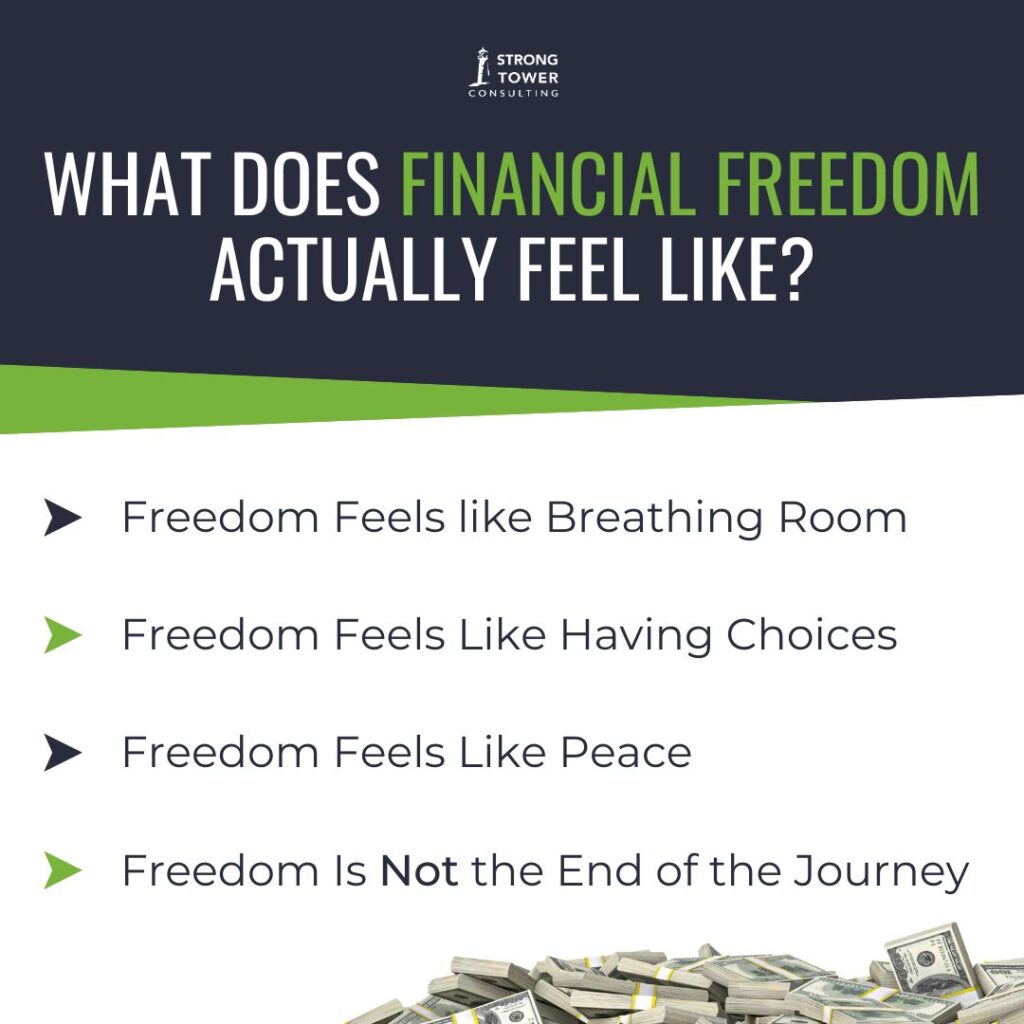
After working with families for years, I’ve found that the feeling of financial freedom usually shows up in three ways: breathing room, choices, and peace.
Freedom Feels Like Breathing Room
Most people don’t realize how exhausting financial stress can be until it starts to disappear.
When you’re carrying consumer debt, every month begins with obligations. Before you’ve bought groceries, paid utilities, or filled the gas tank, part of your paycheck is already committed to credit cards, car loans, personal loans, or other debt payments.
That creates stress. Sometimes debilitating stress – like when you don’t even want to look at your checking account numbers.
You find yourself hoping nothing unexpected happens. You hesitate before opening your banking app. You mentally calculate whether you’ll make it through the month. And when life throws a curveball, as it inevitably does, that pressure increases.
The transmission goes out. The water heater quits. Someone gets sick. The roof starts leaking.
Without savings, these situations often become emergencies. And emergencies often become more debt.
It’s a cycle many families know all too well.
One of the first things people notice when they reach financial freedom is a deep sense of relief – the relief of knowing that an unexpected expense doesn’t automatically become a crisis. The relief of having money set aside for emergencies. The relief of seeing debt balances disappear instead of grow.
I often tell people that financial freedom isn’t about getting rich. It’s about creating breathing room.
It’s about having enough margin in your finances that every surprise doesn’t feel like a disaster. It’s about knowing that life can happen without sending your entire financial plan into chaos.
Imagine what it would feel like to have six months of expenses sitting safely in an emergency fund. Imagine what it would feel like if your paycheck wasn’t already spoken for before it arrived.
That’s breathing room.
Freedom Feels Like Having Choices
One of the hidden costs of debt is that it limits your options.
When a large portion of your income is tied up in monthly payments, your financial obligations begin making decisions for you. You may stay in a job you dislike because you can’t afford to take a pay cut. You may postpone a dream because the numbers don’t work. You may pass on opportunities because your finances are stretched too thin. You can’t give to a hurting family or an organization you care about because you just don’t have it.
Debt has a way of shrinking your world.
Financial freedom does the opposite.
When your consumer debt is gone and your emergency fund is in place, you gain flexibility. You gain options. And options are powerful.
Maybe you decide to pursue work that’s more meaningful. Maybe you can leave home for a while to take care of an aging parent who needs support. Maybe you finally take the family vacation you’ve been talking about for years without putting it on a credit card. Maybe you increase your giving because you’re no longer sending money to lenders every month.
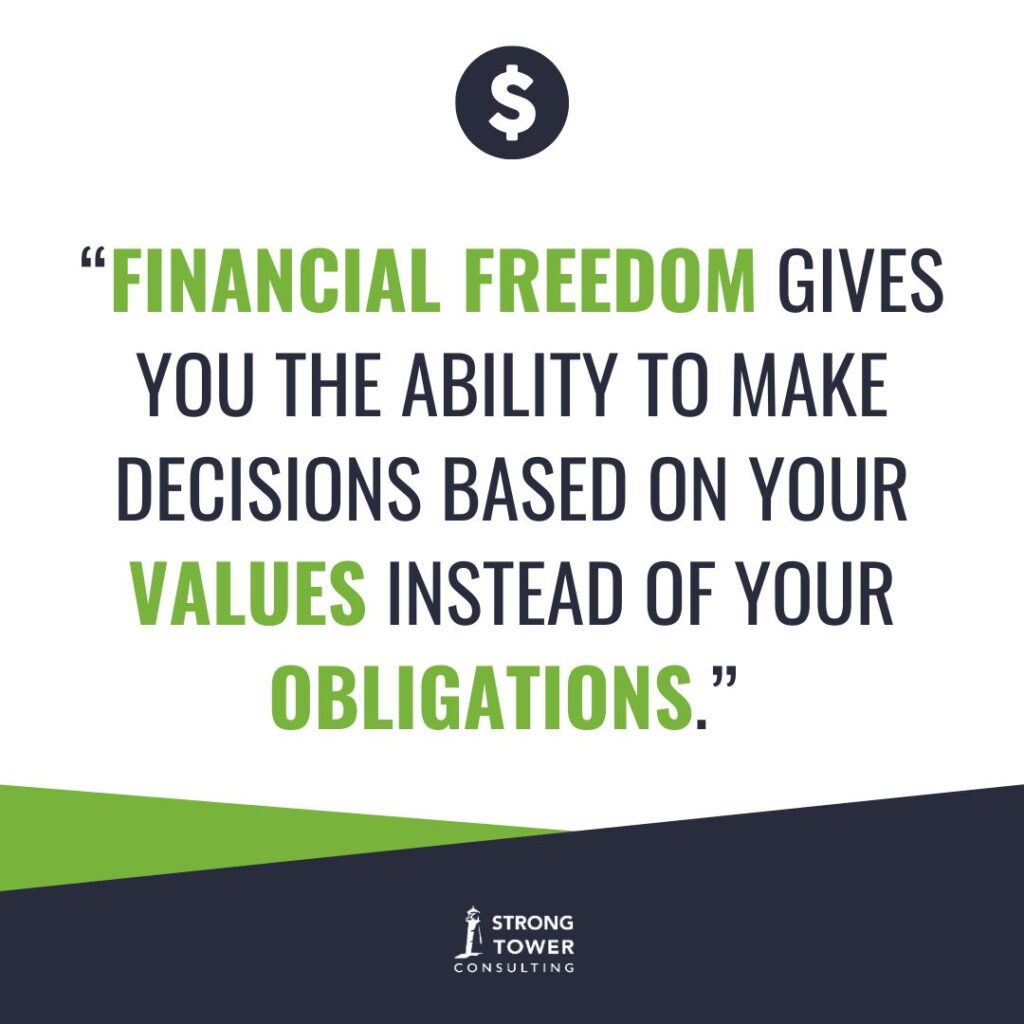
Financial freedom gives you the ability to make decisions based on your VALUES instead of your OBLIGATIONS. It allows you to say yes to opportunities instead of constantly calculating whether you can afford them.
Many people think money creates happiness. I’m not convinced that’s true.
But I do think margin creates options.
And options create opportunities.
That’s one of the greatest rewards of getting your financial house in order.
Freedom Feels Like Peace
Of all the ways I could describe financial freedom, this is probably the most important.
Peace.
Not luxury.
Not status.
Not impressing other people.
Peace.
When I meet with people who are struggling financially, they often describe the same emotions. They avoid looking at their bank balances. They dread conversations about money with their spouse. They feel guilty after making purchases. They worry about the future. They feel overwhelmed by everything they know they should be doing.
Financial stress doesn’t stay neatly contained inside your checking account.
It follows you into your marriage. It follows you into your sleep. It follows you into your workday. It follows you into your emotional health.
Money problems have a way of touching nearly every area of life. In every decision we make, money directly and/or indirectly plays a role.
That’s why I believe the emotional benefit of financial freedom is often greater than the financial benefit.
There’s a peace that comes from knowing your bills are paid. There’s a peace that comes from knowing you can handle an emergency. There’s a peace that comes from living according to a plan instead of constantly reacting to financial surprises.
I’m not suggesting that financially free people never experience stress. Life will always have challenges.
But those challenges no longer carry the added weight of financial chaos.
In many ways, peace is what people were searching for all along. They thought they wanted more money, but what they really wanted was less stress.
Here is a question to think about:
If money has never given you what you hoped it would give you, what were you hoping it would give you?
For some people, the answer is security.
For others, it’s significance.
For others, it’s approval, comfort, control, or peace.
The problem is that money was never designed to provide all of those things. Yes, money can solve some problems, but it can’t solve every problem. That’s why some people earn more and more money yet never feel any more secure. The target keeps moving because they’re looking to money to provide something it was never meant to provide.
What financial freedom does provide is margin. It removes many of the financial pressures that create stress and anxiety. It gives you room to breathe. It gives you options. It helps create peace.
And for many families, that’s what they were really searching for all along.
Freedom Is Not the End of the Journey
One of the biggest misconceptions about financial freedom is that it’s the final destination.
It’s not.
It’s a milestone.
An important milestone, but still a milestone.
Once you’ve paid off consumer debt and built a fully funded emergency fund, a new chapter begins. Now you can give like crazy. Now you can focus on building wealth. Now you can invest for retirement. Now you can save for future goals. Now you can build assets.
This is why I make a distinction between financial freedom and financial independence.
Financial freedom is paying off all consumer debt and building a fully funded emergency fund.
Financial independence is having enough assets and investments to support the lifestyle you desire without needing to work.
Financial freedom comes first.
Financial independence comes later.
The foundation has to be built before the house can stand.
And for many families, reaching financial freedom is the turning point that makes everything else possible.
One Step Closer
As we celebrate freedom this month, I want to encourage you to think about your own financial life.
Not where you wish you were.
Not where someone else is.
Not where you think you should be.
Just where you are today.
Then ask yourself one simple question:
What’s the next step I can take toward greater financial freedom?
Maybe it’s creating a budget. Maybe it’s paying off a small debt. Maybe it’s building your emergency fund. Maybe it’s finally sitting down and making a plan.
Whatever that step is, take it.
Financial freedom isn’t about becoming rich. It’s about removing the things that control you.
Every budget you create, every debt payment you make, and every dollar you save is another step toward a life with more breathing room, more choices, and more peace.
The question isn’t whether you’re completely free yet.
The question is what step you’ll take next.
Jump on a FREE consultation call with me if you’d like help in taking that step.